Friday, May 29, 2009

Start a Conversation


Meet Luis. At 18, he has a mature appreciation for what technology can do. The son of Mexican immigrants, Luis sees technology as "a better way to connect with families, connect with friends, a better way to help me improve my studies and find out information and use it for the community, not just for myself."
Luis shares his story in Edutopia's Digital Generation Project, a rich collection of content that was just released this week. Ten youth portraits are the heart of the project (although we adults get plenty of opportunities to weigh in, too).
This content is freely available for you to reuse--on your blog or school website, in class, at a parent or staff meeting, or wherever else you might want to take the conversation about today's digital youth.

Monday, May 4, 2009

PBL Buzz

Wayne D'Orio's article ("The Power of Project Learning") in the May issue of Scholastic Administrator takes a good look at the current PBL landscape and pushes readers to consider why more educators aren't using this real-world approach. One theory: PBL may be too hard for teachers to tackle without support. In a Q&A at the end, Chris Lehmann of Science Leadership Academy explains how schoolwide systems (for everything from planning to assessment to technology integration) set the stage for project success at his Philadelphia school. No arguing with that, but I continue to be impressed by creative types like Terry Smith (also quoted) who are determined to make PBL work, despite the obstacles. Seems to be a mixed landscape at the moment, with some excellent schoolwide models and some islands of innovation.
I'd be eager to hear more reflections from PBL advocates. What helps you move forward with this approach? What gets in your way? What more can we do as a community to advocate for what you need to succeed?

Thursday, April 9, 2009

Students, Meet Aquaman


The first time I met Christopher Swain, he had just completed swimming the length of the Columbia River, becoming the first swimmer to cover all 1,243 miles of this great waterway. Throughout his treacherous journey, he climbed ashore to raise awareness of the Columbia's fragile health and the dislocated peoples whose culture is centered on the river.
This year, Swain is giving himself a new challenge: swimming 1,000 miles along the Atlantic shore. He jumps into the cold saltwater on Earth Day, April 22, at Marblehead, Mass., and estimates it will take 200 "swim days" to reach the Tidal Basin in Washington, D.C. He'll spread out those days in the water so that he'll have time to visit as many as 2,000 schools along the way. At each school, Swain--a father of two--will challenge students to come up with their own projects "to improve the health of our ocean planet." After years of environmental activism, Swain says, "I'm done telling kids what to do." Getting them to challenge themselves is all part of the deal.
If you want to bring Swain's dramatic story into your classroom, you can request a school visit at his Web site, Swim for a Healthy World. Or, follow his unfolding adventure on Changents, where he'll be uploading videos and updating a blog. He'll be using Skype and other tools, too, to connect with students who live far from the coast.
I'll be updating Swain's journey with occasional posts in Spiral Notebook (starting with this one). Let me know if your students take up his challenge.
Photo by Basil Childers

Tuesday, March 24, 2009

I Promised So Here Goes, Mom

"I, Suw Charman-Anderson, will publish a blog post on Tuesday 24th March about a woman in technology whom I admire but only if 1,000 other people do the same."
Suw met her challenge honoring Ada Lovelace's birthday today, and I'm helping take it over the top with my pledge to honor a woman in technology who I admire. She's my Mom, Kathy Krauss. Those who know her admire Kathy for everything but technology, so let me explain (save your eye rolls, siblings!) Mom is a scholar, mostly retired now, who she teaches one perennially sold-out course each spring called World Religions. Today we met for lunch and she asked me how to set up a community space on the Web where she, her students and guests could continue their conversations beyond the weekly class. After figuring out the functions they might require, I agreed to set up a wiki for them. (PBWiki has a new "comments" function that makes any page more blog-like; I think that's the wiki platform I'll use.) I told her to poll her class for the wikiliterate and to put someone in touch with me who could be point person, populating the site and helping students familiarize themselves with its functions.

I kind of bent the rules with this post-- Among the 1,000 women celebrated today, my Mom isn't likely to come in in the top tier of female technology innovators, yet she deserves a shout out for being solidly in the game. I'm impressed that Mom constantly wants to improve her teaching, and sees the value of connecting her students in new, significant ways. I'm impressed that she isn't daunted by the specter of new technology (but you'll notice I did a work around on having HER manage the site.) This is going to be a lot of fun.

Saturday, March 21, 2009

Happy Spring


When First Lady Michelle Obama spent her Friday (the first day of spring) turning over soil for a new White House garden, I could imagine the smile lighting up Michael Pollan’s face. Author of The Omnivore’s Dilemma and point man for eating locally, Pollan has been an outspoken advocate for converting some of that South Lawn to garden beds.

But best of all was the news that fifth-graders from Bancroft Elementary in the District were on hand to help. They’re already green thumbs, thanks to their school gardening program. Their trip to the White House sounded like more than a photo opp. The students will be invited back to help with planting, and again to harvest and cook with fresh produce. Lots of learning opportunities ahead.

The Edible Schoolyard concept has spread far and wide since California chef Alice Waters got things growing at a middle school in Berkeley, Calif. Developing and sustaining a strong outdoor education program, including gardening—that’s takes ongoing effort. In my hometown of Portland, Ore., Lewis Elementary School has engaged the community in developing a multifaceted outdoor learning program that makes use of gardens, greenhouse, rain barrels, and even a covered outdoor classroom. (Hat tip to Principal Tim Lauer.)

Garden season has me thinking about what Pollan said during a lecture stop in Portland earlier this year. Convincing the new president to be an advocate for sustainable agriculture will require a strong push from the people, Pollan said, adding, “He needs to feel the wind at his back.” Maybe he just felt a little breeze from the South Lawn.
Photo by Tim Lauer

Friday, February 27, 2009

Reinventing PBL Flickr Group Reaches 100 Contributors!

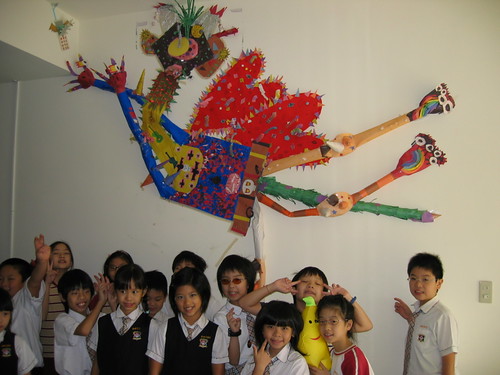
Midnight Chickadee at Kang Chaio Bilingual School, Taipei (hat tip to Terry Smith)

I posted a query to Classroom 2.0 two weeks ago about computing environments and Greg Tracy contributed several helpful ideas. Several days later I announced that the Reinventing PBL Flickr Group was one member shy of 100. Greg was paying attention and now I'd like to give a hearty welcome to Mr. 100, Greg Tracy!
If you want to see and show others what PBL looks like in action, take advantage of this Group.
What ways can it be useful?
  • Look for projects to emulate or join.
  • Talk to contributing teachers about their projects.
  • Ask kids: What three photos would best tell the world what we're about?
  • Think about the stories projects tell, and how documenting them on the Web transmits their power to others.
  • Start a discussion with other pbl-minded folks in the group forum.
  • Set the pool pictures on "slideshow" and project the images as participants gather at your next staff meeting or workshop.
In what other ways can pictures of PBL inform, persuade and celebrate? I'm all ears. Please join the Reinventing PBL Flickr Group!

Thursday, February 12, 2009

The Art of Community Change

In "Passing Empowerment Down through the Arts," in the current issue of Edutopia, Bill Strickland tells me about the journey he began 40 years ago when an art teacher changed his life. He's been changing lives ever since, first in his hometown of Pittsburgh, Pa., and now in other communities across the country (and beyond). His unique vision combines arts and mentoring to keep young people engaged in learning, plus high-powered job training so adults can lift their families out of poverty. It's a potent formula for creating hope in the neighborhoods that need it most. Strickland also tells his story in this remarkable TED presentation, where jazz legend Herbie Hancock accompanies the artful storyteller. And if you want more details on how this all unfolded, check out Strickland's recent autobiography, Make the Impossible Possible.